
Enterprises procuring promotional products often confront a conundrum: Constrained funds yet aspirations for maximal brand exposure through giveaways and client immersion. Squandered spends sans yields not only dissipate assets but forfeit promotional marketing opportunities. This discourse unveils premier promotional budget optimization strategies, empowering scientific fiscal blueprints—from modest to munificent outlays—to unearth fitting swag, ensuring fiscal prudence amplifies corporate branded merchandise impact and gratification.
What Does the Promotional Budget Determine? (Key Influences on Swag Selection and Scale)
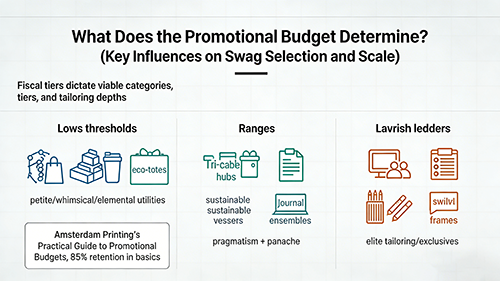
Fiscal tiers dictate viable categories, tiers, and tailoring depths. Low thresholds favor petite, whimsical, or elemental utilities like keychains, fidget organizers, or eco-totes—per Amsterdam Printing's Practical Guide to Promotional Budgets, ideal for volume blasts yielding 85% retention in basics. Mid-ranges equilibrate pragmatism and panache: Tri-cable hubs, sustainable vessels, or journal ensembles. Lavish ledgers unlock elite tailoring or exclusives: Desk suites, bamboo multi-tools, or swivel frames.
Budgets calibrate volumes and scopes: Austere suits mass dispersals for ubiquity; opulent refines for VIP curation. They modulate customization and conveyance: Generous greenslight bespoke motifs and ornate enclosures; frugal fuses ingenuity for perceived plenitude. Moreover, outlays sculpt tactics and triumphs—offline galas, expos, or digitals; interactive romps or festive flurries. Plentiful provisions perpetuate prestige; lean leans on levity and longevity for transient thrusts, as in Imprint Engine's Essential Guide to Promotional Budgets, where ROI-focused tiers drive 300% uplifts in targeted spends
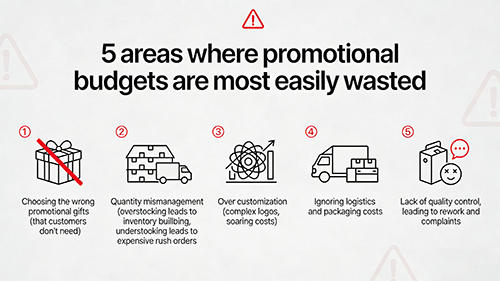
5 areas where promotional budgets are most easily wasted
Many companies don’t fail at promotional marketing because they spend too little.
They fail because they don’t spend their promotional budget wisely.
In reality, a few common mistakes can quietly increase costs without delivering real results.
The first issue is choosing the wrong promotional products.
If a promotional gift does not match the target audience or real use cases, it adds little value. No matter how much you spend, unused items quickly become wasted budget instead of brand exposure.
Another common problem is poor quantity planning.
Underestimating demand often leads to expensive last-minute reorders, while overestimating results in excess inventory and higher storage costs. Both scenarios reduce the overall return on your promotional budget.
Over-customization is another hidden cost driver.
Large logos, complex printing techniques, and repeated design revisions can significantly increase unit costs and extend production timelines, without necessarily improving brand impact or customer recall.
Many businesses also underestimate packaging and logistics costs.
While each expense may seem small, shipping, packaging materials, and handling fees can add up quickly—especially for international promotional campaigns and bulk orders.
Finally, lack of proper quality control can drain your budget after production.
Defects, rework, and customer complaints not only increase costs but also damage brand reputation and trust, which is far more expensive to fix in the long run.
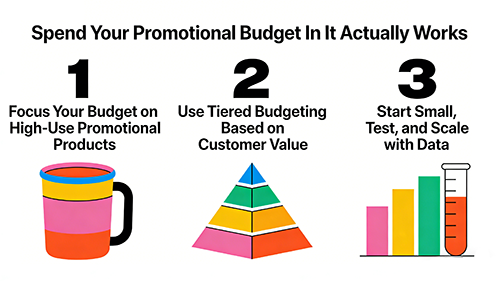
Spend Your Promotional Budget Where It Actually Works
A smart promotional budget strategy is not about spending more.
It’s about allocating budget to promotional products that deliver real results.
Here are three proven ways to make your promotional budget more effective.
1. Focus Your Budget on High-Use Promotional Products
Everyday items create the highest return on investment.
Promotional products used in daily office work, commuting, and home offices stay visible for longer and deliver repeated brand exposure.
In promotional marketing, usage frequency equals brand visibility.
The more often a product is used, the more value it generates from the same budget.
2. Use Tiered Budgeting Based on Customer Value
Not all customers should receive the same promotional gifts.
A tiered promotional budget helps you match gift value to customer importance.
Standard promotional items work well for general customers, while premium promotional products are better suited for VIP clients, key partners, and high-value accounts.
This approach improves perceived value without increasing total promotional spending.
3. Start Small, Test, and Scale with Data
Instead of committing your full promotional budget upfront, start with small batch test orders.
Trial runs help you evaluate product quality, customer response, and overall cost efficiency.
Use real data—such as engagement, feedback, and reorder performance—to decide where to invest more.
Data-driven decisions lead to more cost-effective promotional campaigns over time.
Quick Reference Table: Promotional Product Customization Budget Benchmarks
Budget Range | Applicable Scenarios | Target Audience Groups | Recommended Gift Examples | Features & Advantages | Notes |
| Low ($1-5/unit) | Mass awareness events, entry-level leads gen | Broad consumers, event attendees | Keychains, fidget desk organizers, eco-totes | High-volume, portable; quick turnaround; fosters initial buzz | Ideal for 1,000+ units; leverage bulk discounts for 20% savings, per volume pricing models |
| Mid ($6-15/unit) | Client appreciation, mid-tier activations | B2B prospects, team incentives | Multi-cable chargers, reusable tumblers, journal covers | Balanced utility/visibility; customizable imprints; 6-8 week lead times | Suits 500-1,000 runs; hybrid personalization boosts retention by 40%, as in targeted campaigns |
| High ($16+/unit) | VIP loyalty, executive gifting, premium launches | C-suite, key partners | Bamboo multi-tools, rotating photo frames, bespoke desk sets | Exclusive tailoring, experiential appeal; enduring prestige; 8-12 week cycles | For <500 exclusives; ROI spikes 5x via emotional ties; allocate 10-15% contingency for customs |
Why Master Promotional Budgeting? Strategic Imperatives for Fiscal Finesse
Adroit apportionment—echoing Improvado's Complete Guide to Marketing Budgets's 70/20/10 paradigm (70% proven, 20% emergent, 10% innovative)—unlocks layered leverages:
- ROI Quantification: Track disbursements against metrics (impressions, conversions), refining for sagacity.
- Cost Containment: Caps avert excesses, channeling to high-yield vectors.
- Operational Agility: Boundaries sharpen foci, expediting enactments.
In corporate promotional budgeting frameworks, fiscal acumen catalyzes clarity—mapping mobilizations, equilibrating equities, and magnifying merits. Methodical scaffolds eschew extravagance or echoes, arming efficacy audits for perpetual polish. For aspirants assaying ascendancy, judicious promotional budget best practices for SMEs inaugurates amplified efficacy, esteem, and eminence.
You May Ask:
1. What factors affect the cost of promotional products?
The cost of promotional products depends on factors such as the product's material, customization options (like printing or embroidery), packaging, shipping, and order volume.
2. How can I maximize my promotional budget for gifts?
To maximize your promotional budget, prioritize high-ROI products that are cost-effective, widely used, and offer long-lasting brand visibility, while keeping customization simple.
3. What are hidden costs in promotional gifts?
Hidden costs may include additional charges for shipping, taxes, customs duties, returns, and expedited production, which can impact your overall budget.
4. How can I lower the cost of customization?
You can reduce customization costs by opting for simpler designs, limiting the number of colors or print locations, and choosing cost-effective printing methods like single-color logos.
5. Is it cheaper to order promotional products in bulk?
Yes, ordering in larger quantities typically reduces the cost per unit. However, ensure that the quantity matches your actual needs to avoid excess inventory and waste.
6. How do I choose the right promotional products within my budget?
Choose promotional products that align with your marketing goals, have a high usage rate, and are practical for your target audience. Items like pens, notebooks, or mugs are often budget-friendly yet effective.
7. What is the impact of minimum order quantities (MOQ) on promotional budgets?
MOQs affect costs because bulk orders usually offer discounts, but larger quantities can increase initial investment. Balance your needs with storage capacity to avoid overspending.
8. How do shipping costs affect promotional budgets?
Shipping costs, especially for international orders, can significantly impact your budget. Be sure to factor in customs fees, taxes, and logistics when planning your overall costs.
9. How can I control costs while ensuring high-quality promotional gifts?
Focus on selecting products that offer a balance of quality and affordability, and simplify customization. Ensure that your product choices align with both your budget and branding goals.
10. How can I avoid overspending on promotional gifts?
Carefully calculate the total cost, including product price, customization, packaging, and shipping. Set a clear budget, plan for quantities carefully, and avoid unnecessary add-ons or complicated designs that can raise costs.